
The Better Path
A Short Story

This story was written for the 2026 GenreCon Short Story Competition. The theme was “Inkling.”
What does that mean? A hint. A whisper of an idea. A suspicion that something is moving beneath the surface.
Or so I’m told.
I’m not sure I fully solved it. I’m not sure anyone ever does. But this was my attempt to chase that word and see where it led.
It didn’t place in the competition—but I’m proud of it all the same.
Sometimes the better path isn’t the one that wins.
I hope you enjoy.
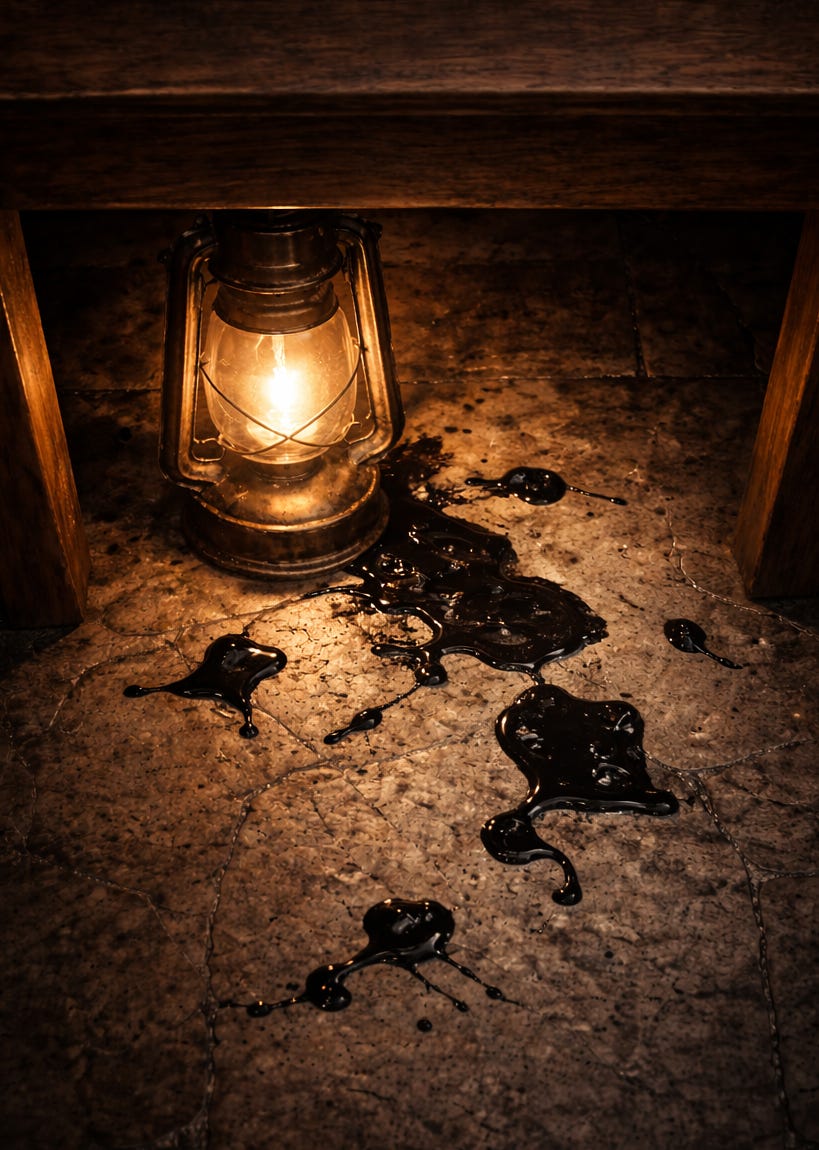
The city’s archivist kept a lantern under his desk, not for the dark, which never stayed away long enough to be a problem, but for the ink. He’d learned a long time ago, when his mentor found him with his face pressed against a ledger, that ink behaves better in the proper light. It thickens when it should and thins when it must. Fickle as it was, it remembered.
“Master Kellen,” said a voice carrying the weight of bureaucratic doom. “The petitioners.”
Kellen looked up. Beyond the hatch of his desk stood the last of the day’s queue—the city’s weary and imaginative. Among them, a butcher convinced his shop was haunted by the ghost of an ox claiming ownership; behind him, two soldiers flanked a hooded figure. His assistant, Joss, gave him a thin smile.
“Ghosts,” Kellen muttered, dipping his quill. “Or madness. This should prove claim.” He inked the title. It floated for a heartbeat, then sank into the page with resignation.
Good ink today.
Joss took the title and handed it over. “Next.”
“Archivist,” the shorter soldier stepped forward. “We need a writ of safe passage.”
“Safe passage?” Kellen snorted. “You must be new.”
“New?” The taller one spat. “Three years in the city’s employ. One at the front. Five months without pay.”
“I meant hope,” Kellen clarified. “Nevertheless. Who is it you intend to pass?”
“Through the West Gate,” the shorter one said. “To the one who besieges us.”
“Peace terms?” Joss gasped.
Kellen glanced at her. “The Council of—what are they calling themselves this week?” Kellen couldn’t keep up. The Council of Rebels changed names like a snake abandoning its skin.
“Rectifiers,” announced the hood figure, pulling their hood back.
Shock passed through him and settled cold.
“Prince Mera,” Kellen whispered, releasing a breath he didn’t know he held. He leaned back from the desk, letting it stand between them.
A ripple dragged his attention, and he glanced under his desk. The lantern’s flicker kept its steady heartbeat. Around its base, the ink misbehaved again—small blots, too deliberate to be accidental.
On bad days, they tugged at him.
His gaze returned to the prince. “Does your father know?”
Mera’s eyes faltered.
“But the law—” Joss began, then stopped. Kellen’s raised eyebrow was enough.
He closed his eyes and pressed his fingers briefly to his brow. Words had weight. He had always believed that was their virtue.
“If I write you this writ,” Kellen started.
“But you can’t,” Joss pleaded.
“Please,” Kellen said, palms raised. “Let me think.”
He turned back to Mera. “If I write this writ, what chance do you have of swaying your uncle?”
Mera answered, his jaw set, his eyes fixed somewhere beyond the room.
Kellen barely heard him.
He dipped the quill.
The ink clung to the tip. Fresh. Eager.
It glided across the paper, ink pooling in the hollow of a letter. Kellen watched it spread out.
To all standing watch at the West Gate, he wrote, these bearers carry a signal of parley and intent. They are to pass unharmed and return unharmed. The city keeps its promises.
He signed it.
Joss folded it and pressed the seal. She made to hand it over.
“Wait,” Kellen said. He wasn’t sure why until the lantern’s flicker caught his eye. A droplet, no larger than a fingernail, edged away from the lantern’s base. He leaned down and held out his hand. The blot settled there, cool and insistent. Kellen took the letter from Joss and held it above his palm. The blot crept to the paper’s edge and smeared itself into the margin, darkening the seal.
He handed the letter to Mera.
The prince eyed the stain. “What does it do?”
Kellen considered it. “It nags.”
“About?”
“Taking a better path.”
Mera huffed a quiet laugh. “We’ve tried better paths. They lead to places where the wise have already died.”
Kellen set his quill down. “Then it will nag you toward foolishness.”
Mera studied him.
The ink crept a fraction farther along the paper’s edge.
Kellen let it.
Thanks for reading.
GenreCon is Australia’s leading genre-writing conference.
A weekend of panels, workshops, industry talks, and community specifically for writers of fantasy, sci-fi, horror, crime, and the rest of the speculative spectrum. It also runs a short-story competition each year on a theme like Inkling, designed to get people pushing weird ideas and unexpected imagery.
This one’s a little different from what I’ve been working on lately. I leaned harder into implication, symbolism, and restraint—letting the ink do more of the talking than the characters.
I’d love to know what you think.
I liked it. You used the word count effectively. I like how you built tension all the way to the last line.